Thursday, February 18, 2016

Rules and Punishment

Knowing the Rules and Consequences!

Disciplining and punishment are the same right?  Wrong!
We cannot use them interchangeably.  The goal of punishment is to penalize a child for misbehavior. The goal of disciplining is to shape behavior.  In my practice I do not advocate for punishment.  My families tell me that once they learn to use discipline they find it more powerful than any punishment. 

Some tips:
1)        Parents, for discipline to work you need to be clear about what specific behavior you are trying to modify and what behavior you wish to achieve.
2)        Find a consequence that is effective for YOUR child.
3)        Be clear in your definition of acceptable and unacceptable behavior
4)        The intensity of the physical pain for the consequence doesn’t make a difference.
5)        This has to be consistent.  A child needs to hear something over and over to make the   connection and children test limits. 

Why does this work?  Behaviors change when children know the ‘rules’ to follow and what will occur when they do not.  Please help your children grow by offering them rules/expectations, consequences, and consistency.


Thursday, November 19, 2015

Something to think about...

A recent study found that people who gave up Facebook for just one week (one week) reported less envy, less sadness and feeling an overall increase in satisfaction with their lives.  

Something to consider just one week free from facebook; how would you feel?

The study was based from the concept that "When we evaluate our lives, we are influenced by social comparisons. How am I doing compared to my peers? Since social media is a constant flow of great news for other people, we wanted to conduct an experiment where a randomised trial group did not log on to Facebook for one week. We were surprised by the results." 

Isn't that true for most of us.

Wanna read more about this study at http://www.happinessresearchinstitute.com/

What I hope this blog post suggests is: We have to have boundaries with social media, cell phones, friends, emails, work, etc...  If facebook isn't your go to or if you can't do a whole week disconnected, what about setting limits for how long and when you connect.  Even disconnecting from a cellphone at the end of the day is restoring.

Consider it!

Saturday, October 10, 2015

Stop asking "How was your day?" and start getting a look into your kids lives

Tired of hearing "fine."  Try out some of these questions: 

Questions a kid will answer at the end of a long school day:
  1. What did you eat for lunch?
  2. Did you catch anyone picking their nose?
  3. What games did you play at recess?
  4. What was the funniest thing that happened today?
  5. Did anyone do anything super nice for you?
  6. What was the nicest thing you did for someone else?
  7. What or who made you smile today?
  8. Which one of your teachers would survive a zombie apocalypse? Why?
  9. What new fact did you learn today?
  10. Who brought the best food in their lunch today? What was it?
  11. What challenged you today?
  12. If school were a ride at the fair, which ride would it be? Why?
  13. What would you rate your day on a scale of 1 to 10? Why?
  14. If one of your classmates could be the teacher for the day who would you want it to be? Why?
  15. If you had the chance to be the teacher tomorrow, what would you teach the class?
  16. Did anyone push your buttons today?
  17. Who do you want to make friends with but haven’t yet? Why not?
  18. What is your teacher’s most important rule?
  19. What is the most popular thing to do at recess?
  20. Does your teacher remind you of anyone else you know? How?
  21. Tell me something you learned about a friend today.
  22. If aliens came to school and beamed up 3 kids, who do you wish they would take? Why?
  23. What is one thing you did today that was helpful?
  24. When did you feel most proud of yourself today?
  25. What rule was the hardest to follow today?
  26. What is one thing you hope to learn before the school year is over?
  27. Which person in your class is your exact opposite?
  28. Which area of your school is the most fun?
  29. Which playground skill do you plan to master this year?
  30. Does anyone in your class have a hard time following the rules?
Guess what?  Its great for spouses too!

Enjoy-Jodi


Taken from 
http://parent.co/30-questions-to-ask-your-kid-instead-of-how-was-your-day/

Saturday, August 1, 2015

Bonus Video-Meditation 101

Check out this great intro to meditation!

Meditation 101

Meditation is not a faith based practice.  It has many  health benefits.  Try it out for 5 minutes a day!

Also, visit http://www.happify.com for guided meditations and other mindfulness-building activities designed by experts. 


Nap? No!

I am enclosing a list of ideas to help if you’re feeling run down, but need to skip the nap.    

Remember naps are only best at 20 minutes or less.  If you’re getting your full 7-10 hours of sleep a nap shouldn’t be needed.  

If you feel tired all the time, consider talking to a counselor about your sleep so that a sleep diet can be sorted out.  You may even need to look into getting a blood draw from your doctor.

Here are some quick ideas for ‘napless’ days!
1) Senses. The easiest way to stay awake is your senses. Why? The more parts of your body that are alert, the less likely it is you will fall asleep. 
Here are a few things to try for your senses:
  • Turn up the lights, as many as you can. If you cannot control         the lights, position yourself close to a window.
  • Taste mint flavors or other stimulating foods.
  • Smell peppermint oil to wake up your sense of smell.  You can also rub this at the base of your neck and back of your head to get a quick energy boost.
  • Listen.  Music, like jazz,  rock, or any song that makes you feel alert.  What is your energy song?
  • Pull on your earlobes
  • Splash your face with cold water or give your self an ice massage on your face.
  • Make a fist with our hands and open them 10-12 times.
  • Get some FRESH air.  Breath in and out a few times before heading back to your work/house/etc..

2) Stressed Eyes.  Take a break from your computer or text and look out a window.

3) Move. Trick your body into being more alert than you feel by getting up and moving.  Do some arm, back, neck and leg stretches to get your blood moving.  Roll your shoulders around.

4) Stay Active.  A few minutes of exercise a day can have a dramatic impact on how awake your body is.
1) Walk whenever you can
2) Take the stairs
3) Make it a habit it work out 2-3 times every week.

5) Breakfast. Protein in the morning will help you make it through the day.  Look at what your eating for breakfast and switch it up.  
  • Egg Whites and turkey.  
  • Make it a power smoothie with lots of good greens and protein.


6) Drink cold water.  Staying hydrated

Some ideas for situations:

At Work
Find someone to talk to briefly, a co-worker or a phone call to a friend.
Change it up; switch tasks.

At School
Take Notes, by activity writing down what is going on in a seminar you will stay alert.
Ask and Answer questions.

At home:
Look at flashing colors. They have loads of apps that display bright luminous colors.
Listen to an energizing binaural beat
Take a cold shower
Do something you really enjoy. Engaged = Awake/Alert

Sunday, May 24, 2015

Live Your Life


Live YOUR Life

Eleanor Roosevelt once said “Do one thing every day that scares you.”
 
This post is going to be short and simple!  As we age, we forget how we want to live our life, with job demands and life demands we find ourselves being less active and having less fun.   

Have you said recently said that all it feels like you get done is work at your job and your household?  YES? Then I encourage you to find one (JUST ONE) thing to do for just you (yes, just you)! 

Why?  Facing a challenged brings us to a place of happiness, absolute calm, and yes PEACE!   Doing and being active allows us to engage in life and when we engage in our lives we do not leave room for self doubt, depression, or anger.

How?  Start in reflection.  
                      What do you wish you were doing right now?  
                      If that doesn’t work, what are your friends doing that you want to do?
                      If that doesn’t work, What activities did you enjoy when you were younger?

What? It may be as simple as adding in a walk in the woods, learning a new cooking technique, taking a class to learn a new skill or as complex as fire walking, traveling…the options are endless and they are yours.
Go for it!

Tuesday, February 3, 2015

Just a Video

In honor of Play Therapy week (February 1-7th) I am posting a video that explains what we Play Therapist do!  Enjoy!

Play Therapy Works!

Friday, December 26, 2014

Yell Less

I am guessing that you are like almost every parent and you want to yell less and enjoy your child(ren) more. 

I have found this idea valuable with the families I meet in my practice and I want to share it so this month I am giving a link for my blog to http://theorangerhino.com/  

Check it out and take the challenge. 

If you take the challenge feel free to send me an email with your feedback and success stories.

Wednesday, November 5, 2014

Special Time

The families I work with find this idea highly effective.  This comes from the book "Transforming the Difficult Child" (By Howard Glasser and Melissa Block).  Parents report that  when they make time for special time with their child(ren), childrens attention seeking behaviors decrease, children do not feel discounted when parents are busy, and parents do not feel guilty when they have to say, "I can't right now, I am tired, but I'm looking forward to our special time." Give it a shot!
 
"Special Time" is a regularly scheduled time.  Think 15 minutes each day.   Let your child(ren) know that you would like to start having time for just the two of you and you can come up with a name for it together.  Explain to them it will be the same time each night and it will be for about 15 minutes.  During the 15 minutes the child can pick the activities (talking, playing with toys, reading a book together, or a short game are the most common).   When the time is up, let them know "Our special time is over for today, I look forward to tomorrow's special time.
 
Things to think about before you start:
1)  Make sure other children are supported during this time as not to get any interruptions. 
2) Turn your phone off or if you have to have your phone on and it rings during the special time come up with a plan to handle the call and not interrupt the special time ("I'm sorry I can't talk right now.") 
3) If you choose to spend more let your child know that the special time is done, but your willing to stay a bit longer.  The child does not add on time you do. 
4) This time is never taken away for bad behaviors, homework problems, etc... 
5) This time is not for discipline or reviewing of the day.
 
Finally, its not the amount of time it is the quality.  Children feel special when they know that time with them is as important to you. 
 

Monday, June 9, 2014

Playful Peace Workshop Series!


Summer is that time every kid looks forward to. It promises to be the "light at end of the tunnel" after a long school year. It is a time to "let loose" and have a great time. But for kids with ADD/ADHD this is a big change, and not always a positive one. The day-to-day structure goes away, the daily routine is gone. In just a few days or weeks, this long-anticipated break can become a potential nightmare for ADHD kids and their parents. BUT, it doesn’t have to be like that!

Every child struggling with ADD/ADHD deserves love, consideration, hope, fun, and attention. This special series for children ages 8-12 years was created for exactly those reasons AND to also give parents a nice break too!
What will your child experience during this workshop series:Play and focus building with art activities such as sand mandala making, indian rattle making, and painting
Games to work on impulse stopping, pausing and thinking
Social skill and friendship building activities and exercises 
Peace building and anger management activities using breathing techniques, mindfulness and movement that teach children how to calm themselves and improve focus.
Benefits that both parents and children will receive from this series: Led by Licensed Counselors and Licensed Meditation and Mindfulness Instructors. Parent Support Group at the end of last day of the series
Impulse and focus building activities
Social Skills and friendship activities
Leave with tips, tools, and materials to help all summer and into the school year
Children who attend get first seats in future ADD/ADHD group workshops


Workshop Dates/Times:       July 21st, 22nd, 23rd from 9:00am until 12:00pm
Location:                                Om2Ohm Meditation & Wellness Center, 324 West Case St.,
                                                 Powell, OH 43065

Cost Per Child:     $90.00 cash, check, Visa/Mastercard accepted
 
This class is limited to 10 children so that everyone gets ample attention so register soon!
 
To verify your child’s eligibility and get registered please contact :
 
Jodi Schermerhorn, MSEd, PC-CR at (614)442-7650/ jodi.sopcc@gmail.com   or
Sheri Mollica-Rathburn C.MI at (614)787-0583/sheri@om2Ohm.com


Wednesday, February 5, 2014

Electronic Devices Oh My!

Many parents ask what to do about screen time, electronics, and social isolation of their children.  That is what encouraged this post.  There are lots of reasons why it is important to establish electronics rules for everyone in your household.  This blog will discuss some of those and answer questions about how to set limits with TV, cell phones, video games, computers and other devices.

Limits are a great tool parents can teach children.  Limits set at home begin to teach problem solving, self and time management, self discipline, and self awareness.  Once you pick your limits stick to them.  If school is closed do not increase or change your rules.
7 ideas
Idea 1: Model It
Make it a way of life and model healthy electronic use.  Do not forget you (despite your child(ren)’s belief) are their best role model.  Model the behavior you want to see.  If you find yourself spending hours on the computer or texting your friends, do not expect your child to behave any differently. Many of my friends leave their TV’s running all of the time as “background noise.”  Turn it off at the end of your show.

Idea 2: Education 
A key to making this a success in your home is to educate yourself on electronics.  If you cannot use them and your kids can, they will/can slip things past you.  It is important for parents to be up-to-date on the latest.  How do you do this?  Well ask your friends, read articles, and ask your kids.  Why not have them teach you.

Idea 3: “A Technology Zones”
These are places in your house where you don’t allow devices (cell phones, TVs, laptops, reading tablets, or video games).  The patio, bedrooms, and dining room are great technology-free zones.

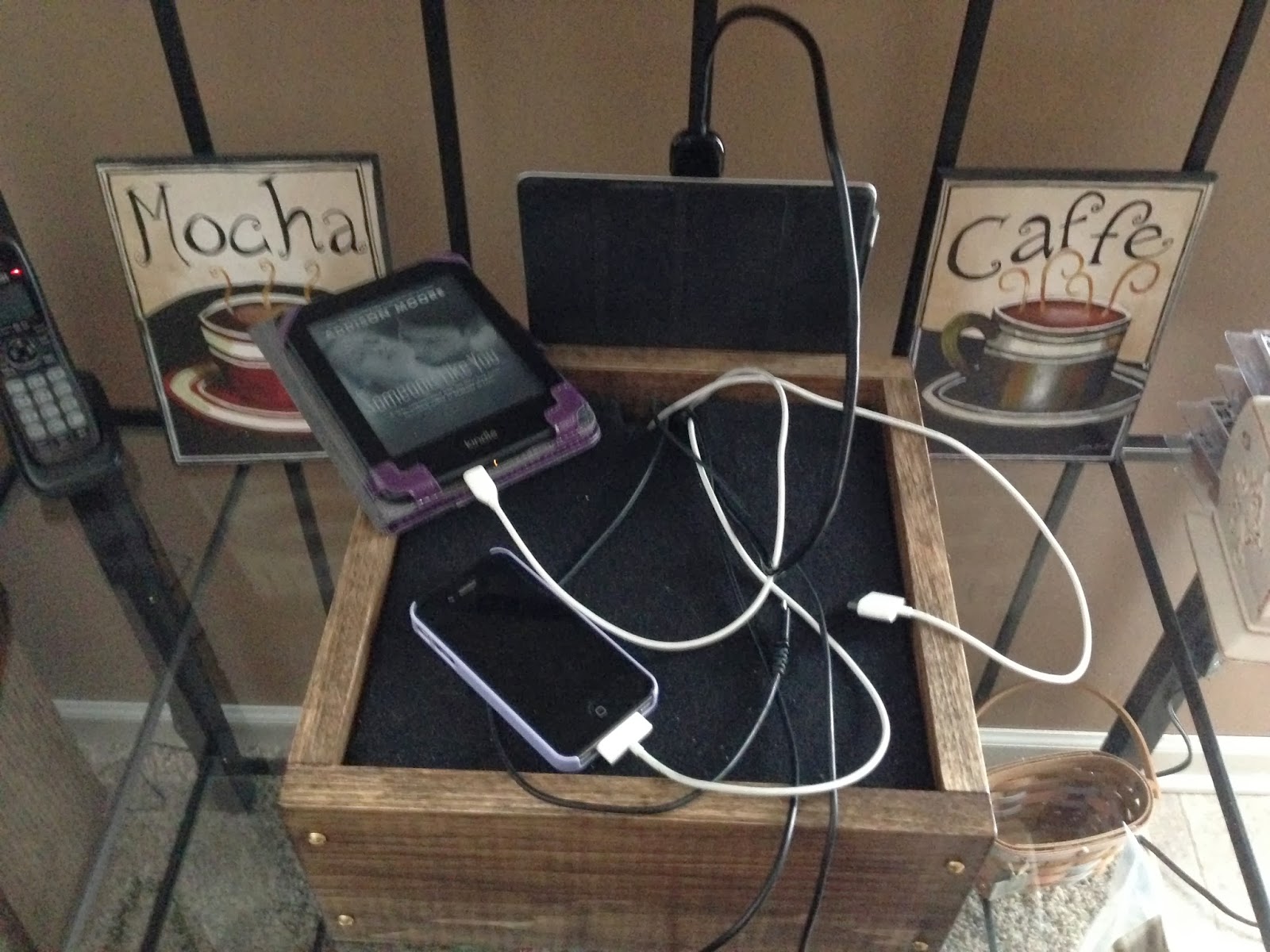
Idea 4: Charging Stations/Unplugged Time Frames.  
My friend, Robin has found this to be a great change in her household.  She stated that it took her three girls a few days to get past the change, but now it has created for increased communication, compliance, and better sleep.  So, make a central space for charging and set aside times for the entire family to become unplugged.  See the posted picture.
Tell your child how much screen time is too much.  Let them take charge of how much and when they wish to use that time.  If your house rule is 2 hours of TV time make it for all devices.

Idea 5: Teach the Risks
It is important for adults and children to have an understanding about the risks of too much screen time.  Explain to your family how violent video games, movies and images can be harmful, how exposure to people who we do not know can risk privacy, and discuss potential dangers of online predators.  Then discuss as a family how you can work together to reduce potential risks, allow your children a chance to offer ideas.

Idea 7: Obtain  Passwords
Depending on their age and your family values obtain passwords to accounts and establish rules about accounts and online services.  

Great so now what, right?
-Encourage other Activities in the “unplugged” and charge times.

-Create an option jar of other activities the family or the child can engage in.  
-Bring the family together. 

-Encourage participation in sports, clubs, volunteer activities or music to help them focus on something other than electronics.  
-Head to your backyard and teach your children how to use nature to reduce stress.  Remember all the fun stuff you did when you were a child and revive those old traditions (bubbles, lightening bugs, mud pies, etc…).

“Screen time is a privileged not a right.”


Thursday, January 16, 2014

Balance

Its a New Year, take the time to look at your life.

Is it in balance?
What can you do to feel more satisfied?
Three Questions to Consider:
1. Where are you currently?
2. Where do you want to be?
3. How can you get there?

Activity 1:      Balance Wheel

1) Draw a circle
2) Divide that circle into 8 parts

3) Label them Career, Financial, Health, Friends and Family, Significant Other/Romance, Personal, Fun/Activities, and Environment.
4) Grab a marker or pencil.

5) Look at your circle.
When moving to the next part of this activity, see the middle point as 0 and the outer edge of each triangle as 10. (0 would mean you are not satisfied in this area of your life and 10 would mean you are 100% satisfied.)

6) Start at the middle of the circle and shade in each triangle the amount you are satisfied. Color all the way

Reflection:
Is your circle round and even all the way around?  Would you want your bike to have tires like this?  If not, then you are probably shocked at what you have in front of you?  If you don’t like the results do the next activity.  Identify how you will focus your energy this year to make changes.

 
Activity 2: My Plan

1)    List the top three areas your life is out of balance.
 
2)    List items for each area that you would like to rework.  What are the reasons they are not at a 8 or 9? Identify them for yourself.

      3)    List the things you must stop doing?

4)    Make a plan.  Remember: Small steps lead to success

Reflection:
“ Does all this clutter make my butt look fat” (book by Peter Walsh Buy here)
                 This book is about a personal organizer he tells the story of a lady who
                   hired him to clean up her garage and basement.  In the process of getting
                   rid of what she did not need (the clutter) other areas of her life started to 
                   balance out. 

As people deal with what is weighting them down they tend to find more satisfaction in other areas of their life.  You can do this too.  Look at your balance wheel (activity 1).  Make a plan (activity 2).

Maybe you have a one sided relationship that you put more effort into.  Do you need to use the word “no” more? Set limits for yourself?  

As you look at your balance wheel and your top three priorities.  Ask yourself two questions; What do I want to accomplish and what is preventing me from doing it?

Click here to visit my practices website!

www.spiritofpeaceclinicalcounseling.com